

Discover the power of goseboze ai tools with this ultimate comprehensive guide. Explore the top tool directory, core categories, pricing structures, reviews, and leading alternatives to revolutionize your workflow.
Introduction: Why Goseboze AI Tools Matter
The generative artificial intelligence market has transformed from a collection of experimental novelties into a multi-billion-dollar bedrock of modern business architecture. In this rapidly shifting ecosystem, thousands of new software platforms surface every single month. For creators, entrepreneurs, developers, and marketers, this hyper-acceleration poses a unique paradox: while the potential to automate complex workflows is higher than ever, finding the exact tool for a specialized task feels like searching for a needle in a digital haystack.
This is exactly where curated curation indexes and frameworks enter the picture. Navigating this sea of innovation efficiently requires structured categorization. The collection known as goseboze ai tools has emerged as a landmark reference point for individuals looking to bypass the noise and pinpoint high-efficacy applications.
Rather than wasting hours scrolling through unverified social media recommendations or testing broken beta products, understanding this framework lets you instantly align software solutions with specific business outcomes. Whether you are looking to scale content production, write robust code, or automate complex client retention sequences, keeping tabs on targeted asset registries can easily save your operation hundreds of hours of manual labor and thousands of dollars in mismatched subscriptions.
What is the Goseboze AI Directory?
The Goseboze AI directory serves as a centralized, deeply structured repository designed to catalog, evaluate, and present advanced artificial intelligence tools to the public. Unlike a standard search engine that skims surface metadata, this directory functions as an intentional taxonomical asset. It breaks down applications by utility, specific engineering constraints, user personas, and output type.
At its core, the goal of this curated index is democratization. By providing an open, readable master architecture of machine learning solutions, it removes the technical barrier to entry for small businesses and independent operators. Users can easily scan historical software packages alongside newly minted platforms to see exactly how a tool creates value, where it is hosted, and what specific problem it solves. This structured indexing turns a overwhelming surge of technical progress into an accessible, actionable map of modern software capabilities.
Deep Dive into the Goseboze AI Categories
The architectural strength of any technical catalog depends entirely on its classification logic. The taxonomy used within the Goseboze AI categories framework breaks software applications down into hyper-specific functional silos, eliminating overlap and accelerating search times.
Instead of bunching random programs under a generic “productivity” label, the directory divides tools into distinct verticals based on concrete operational outputs:
- Audio & Voice Engineering: Software focused on voice isolation, text-to-speech synthesis, acoustic noise removal, and automated audio mastering.
- Copywriting & Text Generation: Systems tailored for short-form ad creation, long-form editorial drafts, search engine optimization (SEO), and programmatic script writing.
- Developers & Engineering Systems: Specialized toolkits that assist human programmers with debugging, translation of legacy code bases, syntax completion, and structural code reviews.
- Images, Video & Digital Art: Platforms built around latent diffusion architectures, generative video production, asset upscaling, and synthetic avatar creation.
- Marketing Automation & Business Intelligence: Analytical and functional models that construct automated pipelines for lead generation, audience segmentation, social bio optimization, and programmatic outreach.
- Presentations & Web Design: Structural design systems that build complete landing pages, user interfaces, or comprehensive pitch decks directly from natural language prompts.
The Complete Goseboze AI Tools List: A Bird’s-Eye View
When looking at the comprehensive Goseboze AI tools list, you can easily see just how massive the entire AI software ecosystem has become. The compilation monitors over a hundred specialized platforms, balancing foundational market giants with innovative boutique applications.
To help visualize how the broader architecture of this directory unfolds, the list tracks core applications that span several key disciplines:
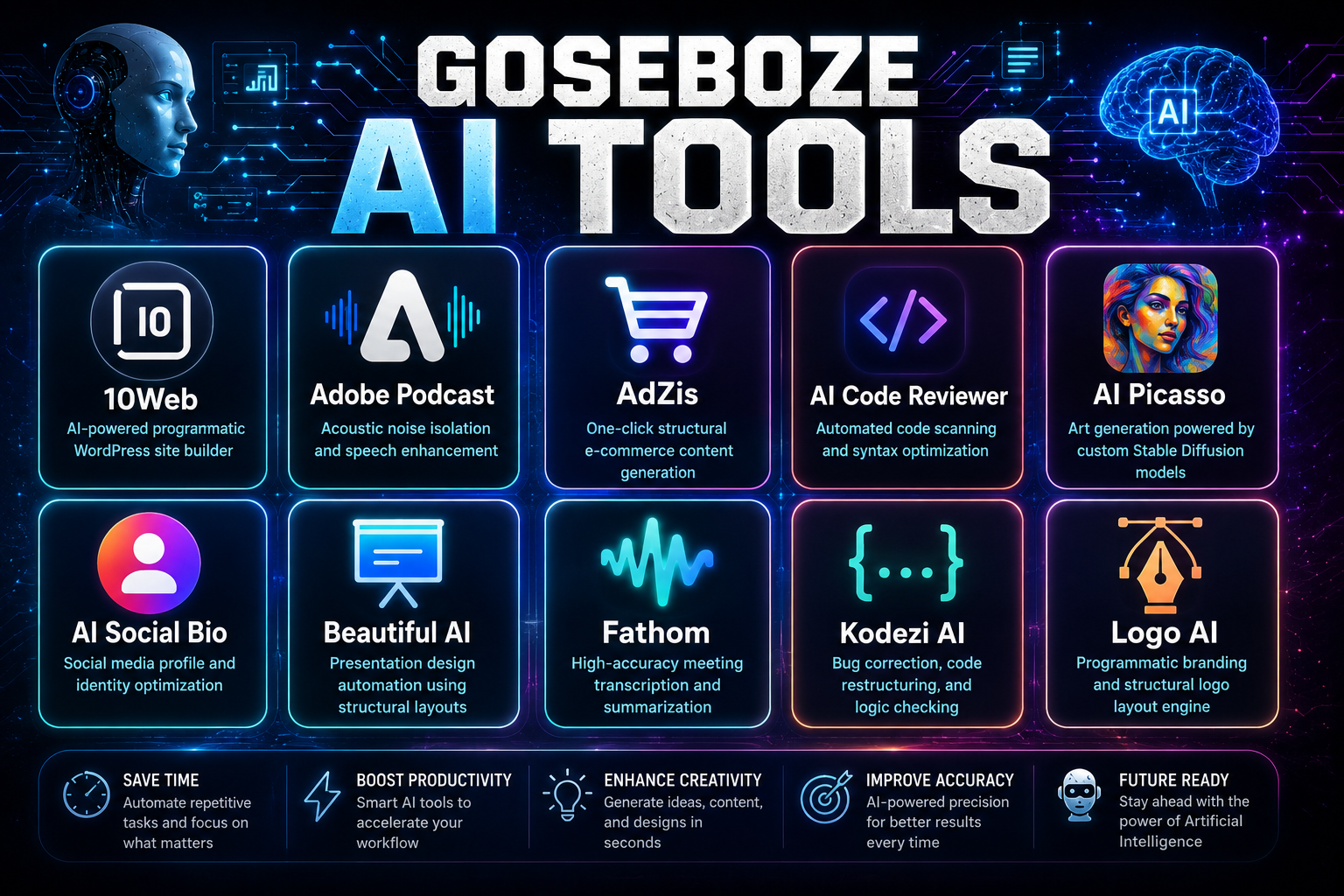
| Tool Name | Core Taxonomy Category | Primary Operational Function |
| 10Web | Web Design & UX | AI-powered programmatic WordPress site builder |
| Adobe Podcast | Audio & Sound Design | Acoustic noise isolation and speech enhancement |
| AdZis | E-commerce Copywriting | One-click structural e-commerce content generation |
| AI Code Reviewer | Engineering & DevOps | Automated code scanning and syntax optimization |
| AI Picasso | Image & Video Creation | Art generation powered by custom Stable Diffusion models |
| AI Social Bio | Marketing Automation | Social media profile and identity optimization |
| Beautiful AI | Presenting & Pitch Decks | Presentation design automation using structural layouts |
| Fathom | Note Taking & Meetings | High-accuracy meeting transcription and summarization |
| Kodezi AI | Code Assistant | Bug correction, code restructuring, and logic checking |
| Logo AI | Image & Graphic Design | Programmatic branding and structural logo layout engine |
By laying out assets this clearly, professionals can build multi-tier operations where tasks flow smoothly from one specialized tool to the next.
Transforming Workflows with Goseboze AI Content Creation Tools
The media landscape requires an unprecedented volume of high-quality digital assets to keep up with consumer demand. Relying solely on manual creative pipelines can quickly create massive content bottlenecks. This makes Goseboze AI content creation tools absolutely essential for modern media teams, corporate communications branches, and independent creators alike.
In text generation and editing, platforms like Copy AI, Frase, AI-Writer, and Longshot AI have changed the game for structural writing. Instead of staring at a blank page, copywriters can use these tools to brainstorm concepts, generate SEO-optimized content outlines, draft entire blog paragraphs, and refine marketing copy for target demographics in seconds.
For example, Frase blends AI content creation directly with competitive search engine research, highlighting exactly which conceptual keywords are missing from your drafts to ensure your final pieces rank highly on Google.
[Raw Content Brief] ➔ [Frase SERP Analysis] ➔ [Copy AI Dynamic Draft] ➔ [Human Editorial Polish]
On the visual side, the content creation list highlights powerful design engines like Craiyon, BHuman AI, Magic Eraser, and D-ID. If a digital marketer needs to clean up a high-end product photo, Magic Eraser uses advanced inpainting models to seamlessly remove unwanted background objects in seconds. Meanwhile, tools like D-ID and BHuman AI generate realistic synthetic videos and avatars, letting companies run personalized video marketing campaigns at a scale that used to require massive production crews and massive budgets.
Streamlining Development with Goseboze AI Coding Assistants
Software engineering is going through a massive shift. As systems grow more complex, developers spend less time writing basic code from scratch and more time architecting systems, debugging logic, and managing integrations. The specialized suite of Goseboze AI coding assistants focuses on automating repetitive coding tasks, lowering development costs while speeding up software release cycles.
       ┌─────────────────────────────────────────────────────────┐
       │   Developer inputs code or logic problem into engine    │
       └────────────────────────────┬────────────────────────────┘
                                    ▼
       ┌─────────────────────────────────────────────────────────┐
       │  AI Analyzes Abstract Syntax Trees & Contextual Logic   │
       └──────────────┬─────────────────────────────┬────────────┘
                      ▼                             ▼
       ┌─────────────────────────────┐┌──────────────────────────┐
       │   Automated Bug Fix Generated││   Optimization Feedback  │
       └─────────────────────────────┘└──────────────────────────┘
These coding assistants handle a wide range of developmental challenges:
- Logic Correction and Debugging: Applications like Kodezi AI and BlackBox AI act as real-time, automated peer-reviewers. They scan script arrays, flag missing variables, point out syntax errors, and offer optimized logic blocks to fix bugs instantly.
- Targeted Hardware Systems: Tools like Duino Code Generator show just how specialized these assistants can be by writing functional, error-free code specifically for Arduino microcontrollers based on simple text descriptions.
- Code Search and Structural Interrogation: Platforms like Lookup and Spellbox radically change how engineers interact with unfamiliar codebases. Instead of digging through hundreds of pages of documentation, developers can ask questions in natural language to locate specific components, map out structural dependencies, or convert complex algorithms into completely different languages like moving from Python to rust.
Scaling Growth with Goseboze AI Marketing Automation
Modern marketing requires managing an incredible amount of data. Teams have to continuously track consumer behavior, optimize ad spend, run hyper-focused email campaigns, and maintain an active social media presence across a dozen platforms simultaneously. Using Goseboze AI marketing automation tools lets businesses run complex, multi-channel growth campaigns with minimal manual oversight.
For instance, top tools like Cortex analyze massive amounts of historical marketing data to tell brands exactly which color palettes, visual styles, and copy phrases will resonate most with their target audience before a campaign even goes live. Meanwhile, platforms like Botify AI and DigitalGenius handle consumer communication directly. By using natural language processing (NLP), these smart assistants understand the true intent behind customer questions, resolving support tickets, qualifying leads, and guiding users through sales funnels 24/7 without needing a human representative.
Even smaller, specialized tools deliver major value. Applications like AI Social Bio use targeted optimization algorithms to craft highly compelling profile bios that maximize user conversion rates. When combined with smart data-gathering pipelines, these tools turn marketing from a guessing game into a precise, predictive science.
Understanding Goseboze AI Pricing Models
Before adding any new platform to your business stack, it is vital to understand the financial side. The directory tracks a wide variety of Goseboze AI pricing models, reflecting the diverse monetization strategies across the current SaaS (Software as a Service) space.
                  ┌─────────────────────────────────────┐
                  │    AI Tool Directory Price Tiers    │
                  └──────────────────┬──────────────────┘
            ┌────────────────────────┼────────────────────────┐
            ▼                        ▼                        ▼
     ┌─────────────┐          ┌─────────────┐          ┌─────────────┐
     │ 100% Free   │          │  Freemium   │          │ Premium/Pay │
     │ Open-Source │          │ Credit-Base │          │ Commercial  │
     └─────────────┘          └─────────────┘          └─────────────┘
Most tools in the catalog fall into three main pricing buckets:
- Purely Free & Open-Source Options: Platforms like Craiyon give users unlimited access to basic image generation without requiring a credit card, making them perfect entry points for testing AI capabilities.
- Freemium and Credit-Based Tiers: The majority of tools use a freemium model. Platforms like Copy AI or Adobe Podcast offer a set amount of free monthly processing credits or compute time. Once you cross that threshold, you can upgrade to a paid monthly plan to unlock higher processing speeds, advanced features, and team collaboration spaces.
- Premium Commercial Software: Specialized, high-performance engines like PhotoAI or advanced marketing platforms require upfront payment or a subscription to access their deep computing frameworks. These professional tiers are tailored for enterprise teams that need dedicated APIs, strict data privacy controls, and guaranteed uptime.
Community Sentiments and Goseboze AI Reviews
Looking at user feedback gives us excellent insight into how these tools perform in real-world business environments. Overall, Goseboze AI reviews point to a major shift in user sentiment, moving from early amusement to a deep appreciation for the practical, time-saving power of these tools.
“Integrating a mix of specialized copywriting and automated image editing tools from the directory completely transformed our agency’s workflow. We cut our content drafting times by nearly 65%, letting our team focus on big-picture strategy rather than manual formatting.”
— Director of Digital Strategy at a mid-sized marketing firm
However, the user community also highlights important nuances. Veteran developers and content creators emphasize that while these platforms are incredibly powerful, they should be treated as excellent co-pilots rather than completely hands-off replacements for human talent. The highest success rates come from a “human-in-the-loop” approach—using AI to handle initial data processing, raw outlining, and structural drafting, while a skilled human professional steps in to provide the final creative direction, strict fact-checking, and brand alignment.
Head-to-Head Comparison: Goseboze AI vs FutureTools
To fully understand where this framework stands in the broader tech landscape, it helps to look at a direct comparison: Goseboze AI vs FutureTools. FutureTools, curated by Liam Porr, is widely celebrated for its clean user interface, highly organized search tagging, and daily platform updates.
When you look closely at how both directories structure their asset indices, several key differences stand out:
| Comparison Attribute | Goseboze AI Directory Framework | FutureTools Platform Index |
| Curation Philosophy | Groups tools into deep tactical workflows and educational resource paths. | Focuses on a broad, highly fluid aggregation of daily software releases. |
| Categorization Depth | Uses highly distinct, specialized functional silos (e.g., separating microcontrollers from web design). | Uses wide, overlapping tag structures for quick browsing. |
| Target Audience | Built for operations managers, full-stack developers, and multi-tier agencies. | Built for independent creators, general tech enthusiasts, and early adopters. |
| Contextual Value | Emphasizes end-to-end tool combinations and structural workflow examples. | Emphasizes individual tool features, user voting metrics, and direct utility links. |
While FutureTools excels as a fast-paced discovery engine for finding the latest standalone software, the Goseboze framework shines when you want to build organized, multi-step production pipelines where multiple specialized tools need to work together smoothly.
Top Goseboze AI Alternatives to Explore
No single directory can capture every single innovation across the global machine learning space. If you want to expand your research beyond this specific framework, there are several outstanding Goseboze AI alternatives that provide incredible depth and unique feature sets.
The most prominent alternative is There’s An AI For That (TAAFT). This massive platform tracks tens of thousands of tools and uses a highly advanced chronological timeline format, letting users see exactly how AI software has evolved month by month since the dawn of the generative AI boom. Another top-tier option is ToolDirectory.ai, which employs an exceptionally strict screening process to ensure only thoroughly vetted, stable enterprise-grade software makes the cut.
Additionally, directories like TopAI.tools offer robust community rating systems and side-by-side comparison features, giving buyers the clear user insights they need to make smart software purchasing decisions.
Practical Examples and Use Cases
To truly understand the power of an AI directory, you need to see how these tools combine to solve real-world problems. When you connect specialized applications into an integrated workflow, the compounding time savings are massive.
Use Case 1: The Modern Content Marketer’s Workflow
Imagine an independent content creator or brand manager tasked with launching a multi-channel campaign for a new consumer product. Instead of tackling every step manually, they can string together several directory tools to build a highly efficient creation pipeline:
[Frase] ➔ Pinpoints core SEO keywords & structures the content outline
   │
   ▼
[Copy AI] ➔ Generates long-form blog text & social ad variations
   │
   ▼
[Magic Eraser] ➔ Cleans up raw product imagery by removing background distractions
   │
   ▼
[AI Social Bio] ➔ Optimizes the campaign launch profiles for maximum conversion
By linking these tools together, a single marketing professional can complete a comprehensive multi-channel campaign rollout in an afternoon—a process that used to require an entire week of cross-department coordination.
Use Case 2: The Independent Developer’s Product Sprint
An independent software engineer wants to build a prototype application and launch a clean landing page over a single weekend. They can maximize their efficiency by leveraging the developer and design categories within the index:
- Step 1 (UI/UX Foundation): The developer uses 10Web to instantly generate a responsive, modern WordPress landing page structure using natural language prompts.
- Step 2 (Core Logic Engineering): They write the core application logic, using Kodezi AI to continuously audit the script, clean up syntax errors, and optimize code efficiency on the fly.
- Step 3 (Platform Integration): If the project involves connecting with physical hardware interfaces, they use Duino Code Generator to instantly draft the required microcontroller configurations.
- Step 4 (Final Code Review): Before deploying the application to production, they run the entire codebase through AI Code Reviewer to identify potential security vulnerabilities and ensure structural stability.
Conclusion: Navigating the AI Era with the Right Tools
The artificial intelligence revolution is no longer a future prediction—it is our current operational reality. As machine learning architectures continue to advance, the dividing line between high-performing companies and lagging operations will come down to one clear factor: how effectively they choose, integrate, and master these automated tools.
Relying on random, disorganized software searches is a recipe for operational exhaustion. Using structured frameworks like the goseboze ai tools directory gives you a massive competitive advantage. It turns a chaotic wave of tech releases into an organized, highly actionable toolkit.
By understanding these tool categories, keeping an eye on user reviews, weighing pricing models, and exploring the best alternatives, you can build custom, automated workflows that eliminate repetitive tasks. The future belongs to professionals who can orchestrate these intelligent systems effectively—and using a well-curated directory is the ultimate way to master that orchestration.

2 Comments
Pingback: Geometry Learn V3 Ultimate Guide to Master Math
Pingback: The Ultimate Guide to ATT My Results Maximizing Your Performance and Career Growth