

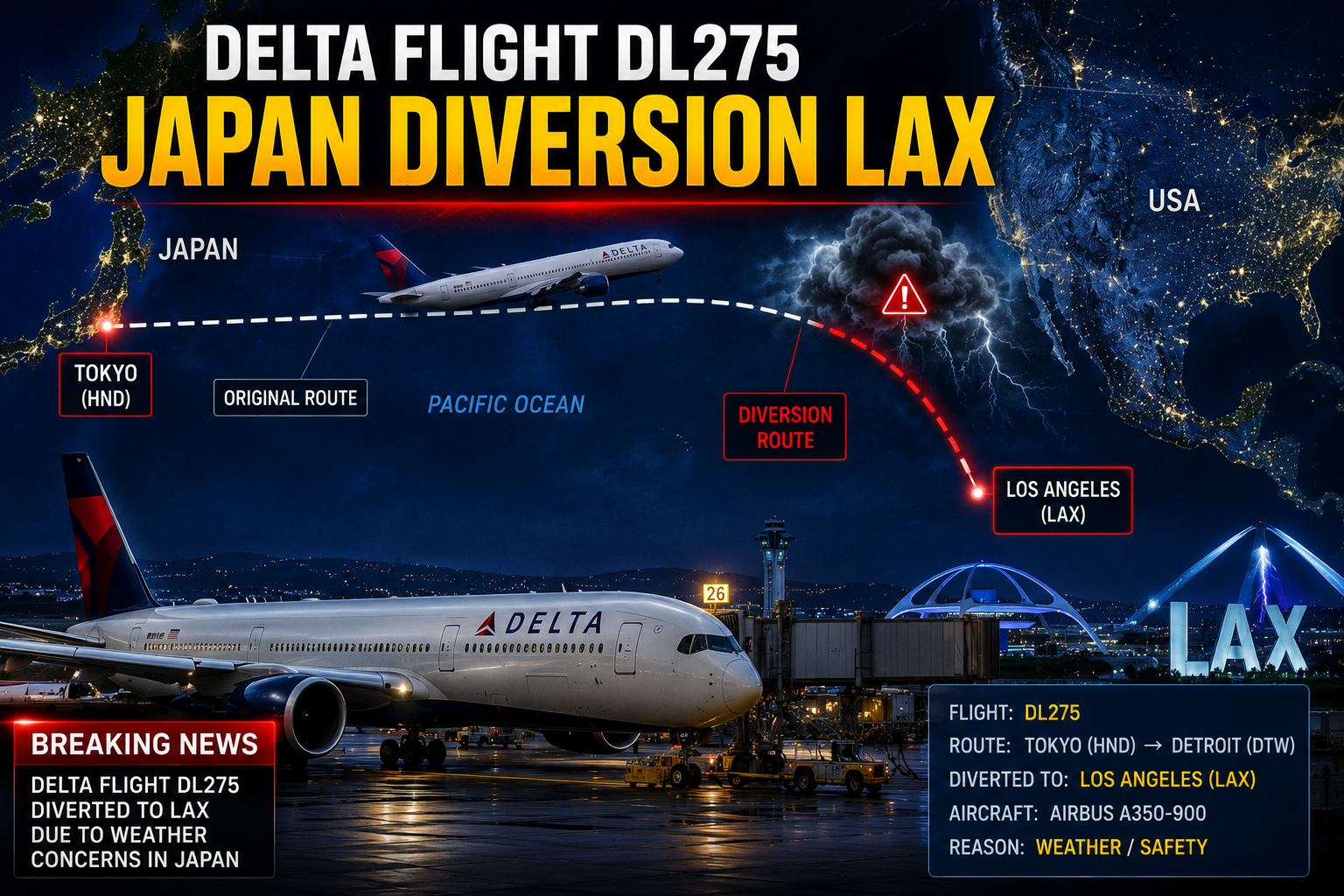
A comprehensive operational analysis of the delta flight dl275 japan diversion lax. Discover the timeline, technical anti-ice malfunctions on the Airbus A350, passenger rebooking strategies, and aviation safety lessons from this transpacific incident.
The global aviation network is a marvel of precision, moving hundreds of thousands of passengers across oceans every single day. Yet, when an unexpected technical variable disrupts a long-haul flight over some of the most isolated terrain on Earth, it sets off a massive logistical, technical, and human operational sequence.
The delta flight dl275 japan diversion lax stands out as an exceptional case study in modern transpacific flight management. What was supposed to be a seamless flight from America’s heartland to Tokyo turned into a twelve-hour endurance test across the North Pacific and back down the West Coast.
Understanding this event matters because it illustrates the delicate balance airlines must maintain between absolute mechanical safety, operational hub economics, and passenger care. It provides deep insights into how modern widebody aircraft—specifically the advanced Airbus A350-900—are monitored in real time, how flight crews navigate complex mid-ocean system faults, and what passengers can expect when international travel encounters severe systemic disruption.
The Origin Flight: Anatomy of Delta DL275 (DTW to HND)
Delta Air Lines Flight 275 is a premier, regularly scheduled transpacific passenger service operating daily out of Detroit Metropolitan Wayne County Airport (DTW) to Tokyo Haneda Airport (HND) in Japan. Serving as a crucial bridge for business and leisure travel between the United States and East Asia, this route covers a massive great-circle distance of over 6,300 miles.
To regularly manage a flight of this magnitude, Delta relies heavily on its flagship widebody twinjet fleet. The aircraft assigned to this specific transpacific crossing was an Airbus A350-900 (specifically an A350-941 variant with the tail registration N508DN). Delivered to Delta in March 2018, this twin-engine aircraft features a highly optimized three-class configuration designed to maximize long-haul comfort:
- 32 Delta One Suites (Lie-flat business class)
- 48 Delta Premium Select Seats (Premium economy)
- 226 Main Cabin & Delta Comfort+ Seats (Standard economy variants)
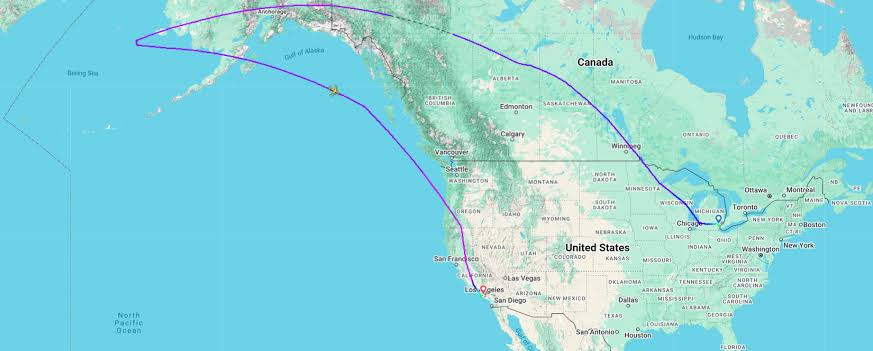
Under normal operating parameters, this flight takes approximately 13 hours and 10 minutes, tracing a route northward across Canada, skimming past Alaska and the Bering Sea, and descending along the eastern coast of Japan. However, during the Delta DL275 May 2025 incident, the operational narrative deviated completely from the standard flight plan.
Chronology of the May 2025 Incident
The challenges for this specific iteration of the Delta DL275 Japan to LAX journey began well before the aircraft even taxied away from the gate in Detroit. A classic cascading airline delay set the foundation for a grueling operational timeline.
The inbound sector for the aircraft—operating as Delta Flight 133 from Amsterdam Schiphol Airport (AMS)—landed over an hour late at DTW, touching down at 1:19 PM local time. This left ground crews with a dangerously compressed window of just 46 minutes before the scheduled 2:05 PM departure time of DL275.
A thorough international turnaround cannot be rushed; cleaning, catering, safety inspections, and complex fueling required more time. Ultimately, the flight pushed back and got airborne at 3:53 PM local time, nearly two hours behind schedule.
The flight climbed smoothly to its initial cruising altitude and headed northwest across Canada toward the Pacific Ocean. For the first several hours, operations were entirely routine. The breakdown occurred nearly seven hours into the flight.
As the Airbus A350 cruised at 38,000 feet over the freezing waters of the Bering Sea—positioned between the International Date Line to the west and the coast of Alaska to the east—the flight deck received a system malfunction alert. Recognizing the severe environmental risks of continuing across the open ocean toward Japan with compromised equipment, the captain made the definitive command decision to abort the crossing, pivot the massive widebody aircraft, and head southeast toward Southern California.
The Technical Malfunction: Under the Hood of the Airbus A350
Initial speculation circulating within aviation forums pointed toward a standard ground de-icing failure, but real-time data and subsequent maintenance logs revealed a much more specific Delta DL275 technical malfunction. The aircraft experienced a severe breakdown within its engine anti-ice system.
The Airbus A350-900 is powered by ultra-efficient Rolls-Royce Trent XWB engines. These powerplants rely on a sophisticated engine anti-ice network that redirects superheated “bleed air” from the engine’s internal compressor stages to the forward lip of the engine cowling (the outer circular housing). This continuous stream of hot air prevents ice from accumulating on the engine inlets during high-altitude cruise or when passing through moisture-laden clouds in freezing ambient temperatures.
Why engine icing is a critical safety threat: If ice forms on the lip of an engine cowling at 38,000 feet, it can break off in large, jagged chunks. These hard sheets of ice are then sucked directly into the engine’s rapidly spinning fan blades, potentially causing catastrophic structural damage, compressor stalls, or total uncontained engine failure.
When the flight crew encountered the Delta DL275 Airbus A350 issue, telemetry indications showed that the anti-ice valves were failing to actuate properly, leading to a 50% reduction in the required anti-ice airflow rate. Over the brutal, sub-zero conditions of the North Pacific and the Bering Sea, flying with a compromised engine anti-ice system was an unacceptable safety risk. The crew acted strictly in accordance with emergency protocols to protect the airframe.
The Critical Pivot: Why the Crew Chose LAX Over Closer Options
When an aircraft suffers a significant equipment failure over the sub-Arctic, casual observers often wonder why the pilots don’t instantly land at the nearest geographic airport. In the case of this Delta flight DL275 diversion, the aircraft was significantly closer to Anchorage International Airport (ANC) in Alaska or Delta’s northwestern transpacific hub at Seattle-Tacopa International Airport (SEA). Instead, the crew flew five hours out of their way to land at Los Angeles International Airport (LAX).
This decision outlines the profound difference between a forced emergency landing (where an aircraft must touch down immediately due to fire or structural failure) and an operational diversion (where an aircraft can safely fly for hours but cannot legally complete its original long-haul journey). The choice of LAX came down to three strategic pillars:
Hub Maintenance Capabilities
While Anchorage handles dozens of cargo widebodies, it is not a primary line-maintenance station for Delta’s long-haul passenger fleet. LAX, by contrast, is one of Delta’s massive West Coast mega-hubs. It features dedicated, round-the-clock maintenance hangars with specialized tooling, diagnostic software, and spare parts specifically allocated for the Airbus A350 and its Rolls-Royce Trent engines.
Fleet Routing Logistics
A stranded Airbus A350 at a non-hub airport paralyzes a multi-million-dollar asset. By routing the wounded aircraft directly into LAX, Delta’s network controllers placed the plane in an environment where it could easily be cycled into a hangar without disrupting secondary routes, allowing another scheduled airframe to step into service if needed.
Passenger Accommodations and Rebooking
Dropping nearly 300 international passengers into a smaller or non-hub airport creates an immediate customer service disaster. Smaller stations lack the hotel contracts, abundant gate space, ground staff, and alternative international flight frequencies required to handle a displaced widebody’s passenger load. LAX offered the ideal ecosystem to process the travelers smoothly.
The 12-Hour Journey to Nowhere: Passenger Experience Aloft
To appreciate the human element of the Delta flight DL275 japan diversion lax, one must look closely at the sheer duration of the flight. When the aircraft touched down on runway 06R at LAX, it was 1:08 AM.
Because of the initial delays in Detroit and the long five-hour return journey from the edge of the Arctic Circle down to Southern California, the passengers had been sealed inside the cabin for 12 hours and 15 minutes.
[Detroit Departure: 15:53] ---> 7 Hours Inflight ---> [Bering Sea Pivot Point]
                                                              |
[LAX Arrival: 01:08 (+1)] <--- 5 Hours Inflight <-------------+
To put this into perspective, the original flight time from Detroit all the way to Tokyo was scheduled for 13 hours and 10 minutes. The passengers effectively endured an entire transpacific flight sequence, consumed their multi-course inflight meals, watched multiple movies, and slept, only to step off the aircraft in the exact same country they had departed half a day prior.
Throughout this marathon “flight to nowhere,” reports indicated that the Delta DL275 passengers safe status was completely maintained. Modern widebody aircraft are extraordinarily redundant. While the anti-ice system issue prevented the plane from safely entering extended freezing moisture zones over Japan, the aircraft itself was entirely stable, pressurized, and under the absolute control of the crew. The atmosphere inside the cabin was one of profound exhaustion and frustration rather than panic.
Ground Operations at LAX: Managing an Unexpected Widebody Arrival
When an international widebody diverts domestically, it triggers a complex response from airport ground operations. Arriving at 1:08 AM, Delta Flight 275 required rapid coordination between LAX Air Traffic Control, Delta ground handling, and airport terminal management.
+-------------------------------------------------------------------+
|               LAX MIDNIGHT WIDEBODY ARRIVAL PROTOCOL              |
+-------------------------------------------------------------------+
|  1. GATE ALLOCATION      -->  Must accommodate A350 wingspan      |
|  2. RAMP CREW DEPLOYMENT -->  Offload massive luggage holds        |
|  3. CATERING & LOGISTICS -->  Provide immediate snacks/water      |
|  4. CUSTOMS COORDINATION -->  Isolate or clear transit passengers  |
+-------------------------------------------------------------------+
|                     RESULT: SAFE GROUND HANDLING                  |
+-------------------------------------------------------------------+
| Note: Operations executed under 24/7 mega-hub infrastructure      |
+-------------------------------------------------------------------+
Because the flight had departed from a domestic U.S. airport (Detroit), passengers did not immediately have to clear federal customs and border protection upon arrival at LAX. However, the sudden influx of hundreds of travelers at 1:30 AM required Delta to mobilize terminal staff during the graveyard shift.
Ground crews had to manage baggage offloading for a fully loaded A350, coordinate transport to local partner hotels, and set up dedicated customer service lines to handle the immense wave of connections that would need to be rebuilt the following morning.
The Delta DL275 Rebooking Process: Getting to Tokyo
Once passengers stepped off the plane into the terminals of LAX, the primary objective shifted to the Delta DL275 rebooking process. Re-routing roughly 300 passengers who have missed their arrival in Asia is a major logistical puzzle.
Delta utilized a tiered approach to systematically resolve the passenger backlog throughout the morning following the diversion:
- Priority 1: Partner Airline Protection: Leveraging its SkyTeam alliance partnerships and joint venture with Korean Air, Delta immediately protected high-priority, business-class, and connecting passengers by booking them onto morning departures out of LAX to Seoul (ICN), where they could easily connect to Tokyo Haneda or Narita.
- Priority 2: Delta’s Own LAX-HND Daily Service: Delta operates its own daily non-stop flights from LAX to Tokyo Haneda. Ground agents filled every available empty seat on the regularly scheduled LAX-HND departure for the displaced Detroit passengers.
- Priority 3: Hub-Routing Protocols: Remaining travelers were routed through secondary West Coast gateways, utilizing Delta segments up to Seattle (SEA) or back to Minneapolis-St. Paul (MSP) to catch subsequent widebody flights bound for Japan.
Because LAX is a massive international gateway, the sheer volume of daily flights to Asia allowed the airline to clear the majority of the stranded passenger backlog within 24 to 36 hours of the initial diversion.
Passenger Compensation and Airline Liability Rules
Because the Delta DL275 engine problem stemmed directly from a mechanical and technical failure rather than unpredictable weather conditions, the airline bore full financial and regulatory responsibility for customer care under United States Department of Transportation (DOT) guidelines.
Passengers affected by the diversion were entitled to, and provided with, specific tiers of structural Delta DL275 compensation:
| Compensation Category | Provision Details | Eligibility |
| Accommodations | Complimentary vouchers for high-quality airport hotels near LAX | All non-local passengers with overnight delays |
| Ground Transport | Round-trip shuttle vouchers connecting LAX terminal to hotels | All accommodated passengers |
| Meal Vouchers | Digital or paper vouchers valid at LAX terminal dining and hotel restaurants | All displaced passengers |
| Systemic Goodwill | Rapid deposit of SkyMiles (ranging from 20,000 to 50,000 miles) or direct travel credits | All ticketed passengers on DL275 |
The Regulatory Context: Under the evolving DOT passenger protection dashboards, airlines that cause a controllable delay or diversion (such as a mechanical failure) must guarantee meal vouchers when a delay extends past 3 hours, and lodging for any overnight delays. Delta’s proactive distribution of vouchers and mileage credits ensured alignment with federal enforcement standards.
Financial and Operational Impact on Delta Air Lines
While passengers suffered massive schedule disruptions, Delta Air Lines faced a severe financial penalty for the mechanical failure. Long-haul widebody diversions are among the most expensive single-flight incidents an airline can encounter.
Independent aviation economists estimate the total operational cost of the Delta DL275 diversion to be approximately $2.3 million. A breakdown of the primary driving expenses highlights the scale of this financial impact:
- Fuel Burn ($500,000): The Airbus A350-900 burns roughly 12,000 to 14,000 pounds of jet fuel per hour. Flying for over 12 hours only to return to the U.S. resulted in massive fuel waste with zero route revenue generated.
- Passenger Care & Rerouting ($800,000): Hotel rooms for nearly 300 travelers in the expensive Los Angeles market, meal vouchers, and paying premium booking rates to clear passengers onto partner airlines quickly accumulated costs.
- Maintenance & Asset Downtime ($300,000): Taking a $300M+ aircraft out of standard rotation, flying in dedicated engine mechanics, sourcing an anti-ice valve assembly, and keeping the airframe offline for days represents an immense loss of operational efficiency.
- LAX Landing Fees & Ground Handling ($50,000): Unscheduled landing fees for international widebodies during off-peak hours incur significant premium structural charges.
Modern Aviation Safety Lessons & The Role of Predictive Maintenance
Every major airline disruption provides a valuable feedback loop for the global aviation industry. The resolution of this transpacific incident has become a compelling argument for the acceleration of AI-powered predictive maintenance technologies.
The engine anti-ice system failure on the Rolls-Royce Trent XWB didn’t happen instantly; it was the final result of subtle mechanical wear. Modern connected aircraft constantly stream performance data back to operations centers via satellite.
By analyzing telemetry trends—such as minor changes in bleed air pressure variations, slight delays in anti-ice valve actuation response times, and historic oil temperature fluctuations—predictive surveillance systems can identify an impending component failure hours or days before a warning light ever illuminates on the flight deck.
[Continuous Aircraft Telemetry] ---> [AI Predictive Analysis] ---> [Flags Valve Sluggishness]
                                                                            |
[Pre-emptive Replacement at Hub] <--- [Alerts Maintenance Crew] <------------+
Had advanced predictive arrays been fully active on N508DN prior to its departure from Amsterdam or during its brief turnaround in Detroit, maintenance systems could have flagged the degrading anti-ice flow rate before the plane took off. This would have allowed technicians to swap out the failing valve on the ground, completely avoiding a costly multi-million-dollar transpacific diversion.
Practical Examples: Navigating an International Flight Diversion
To make this Delta DL275 news update highly actionable for contemporary international travelers, let’s look at three realistic scenarios based directly on the events of this transpacific diversion. These examples highlight exactly how to protect yourself if your flight suffers a mechanical breakdown over the ocean.
Scenario A: The Business Traveler with Tight Deadlines
- The Situation: You are seated in Delta One on DL275, heading to a vital corporate summit in Tokyo. The flight diverts to LAX, landing at 1:08 AM.
- The Action Plan: Do not wait in the massive customer service line that forms at the gate. While the plane is taxiing or immediately upon entering the terminal, open your Fly Delta App and use the digital rebooking assistant. Simultaneously, place a phone call to the premium medallion loyalty line. Because premium cabins have top tier rebooking priority, you should look specifically for alliance partner flights (like Korean Air through Seoul) leaving early that morning, rather than waiting for Delta’s next standard daily departure to Haneda.
Scenario B: The Leisure Family Trapped on the Graveyard Shift
- The Situation: You are traveling with young children in the Main Cabin. You step off the plane at LAX at 1:30 AM, completely exhausted, with all your checked baggage locked deep in the plane’s cargo holds.
- The Action Plan: Approach the gate agent or the dedicated customer service desk immediately to secure your physical or digital hotel and meal vouchers. Understand that during a domestic diversion of an international flight, your checked bags will generally stay with the aircraft or be transferred directly to your new flight; you will not collect them at baggage claim. Ensure your carry-on luggage always contains essential medications, basic toiletries, and a change of clothes to comfortably survive a 24-hour hotel stay without your primary luggage.
Scenario C: Securing Long-Term Compensation
- The Situation: You finally arrive safely in Tokyo, but your vacation has been shortened by an entire day, and you had to pay for a night at a Tokyo hotel that you never slept in.
- The Action Plan: Keep every receipt from your journey, including your original boarding passes, your revised itinerary, and any out-of-pocket expenses incurred during the delay. File a structured, polite complaint directly through Delta’s corporate customer care portal. State clearly that the diversion was due to a controllable mechanical malfunction (the engine anti-ice system). Request a formal refund for the missed hotel night in Tokyo and ensure that the goodwill SkyMiles or travel vouchers offered match the severe 24-hour disruption of an international itinerary.
Conclusion
The story of the delta flight dl275 japan diversion lax is a compelling reminder of the complex realities behind modern commercial aviation. While a twelve-hour flight that returns you to your point of origin is undeniably frustrating, the incident highlights the uncompromising safety culture that keeps global air travel secure. The flight crew’s decision to prioritize airframe integrity over schedule adherence reflects correct operational decision-making.
For the aviation industry, this incident highlights the critical need for deeper investment in line-maintenance turnaround windows and predictive maintenance AI analytics. For the everyday traveler, it serves as a masterclass in modern consumer rights, demonstrating how an airline’s robust mega-hub infrastructure can safely manage, house, and re-route hundreds of displaced passengers during a mechanical setback.
By understanding the technical breakdowns, operational logistics, and consumer frameworks that define these rare events, passengers can navigate the unpredictable skies with greater confidence, patience, and tactical awareness.

1 Comment
Pingback: Geometry Learn V3 Ultimate Guide to Master Math - wikiblog.co.uk