

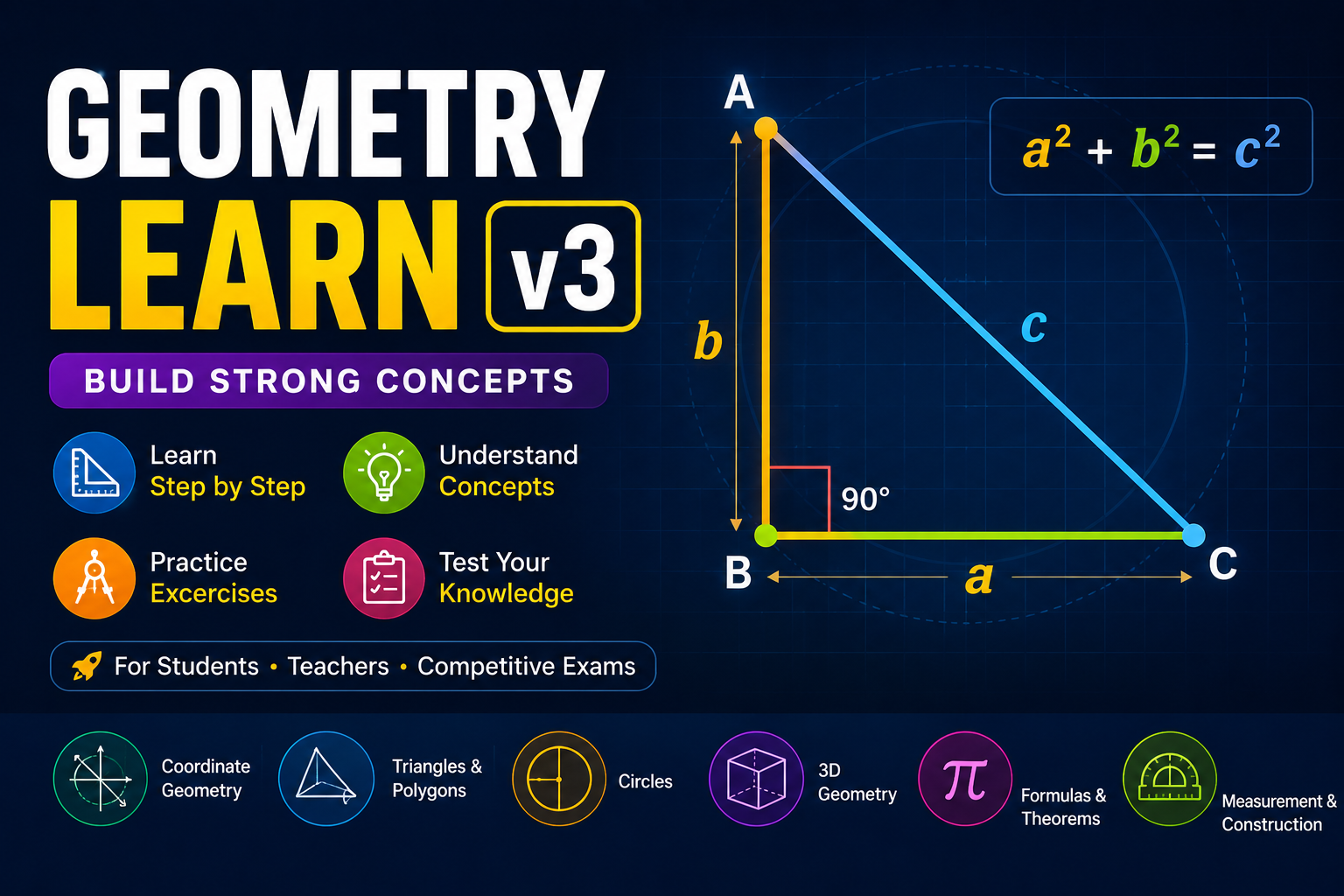
Master spatial mathematics with Geometry Learn V3. Explore our comprehensive guide covering 2D and 3D geometry, interactive online tools, formulas, exam prep, and reviews.
Introduction: Why Spatial Mathematics Matters
Geometry is far more than a collection of dusty theorems and cryptic symbols scrawled across a chalkboard. It is the fundamental language of our physical universe. From the microscopic, hexagonal lattices of snowflake chemistry to the staggering structural calculations required to anchor a modern skyscraper against seismic forces, geometry governs how form interacts with space. For generations, however, the human brain—an organ optimized for tracking moving objects in three dimensions—has been forced to learn this profoundly spatial subject through flat, static ink on paper.
This cognitive disconnect is exactly why a revolution in mathematical pedagogy was necessary. Enter Geometry Learn V3, a state-of-the-art framework engineered to bridge the gap between abstract mathematical theory and tangible, intuitive visualization. Whether you are a high school student panicking over an upcoming standardized test, an engineer brushing up on spatial vectors, or an educator searching for a way to make proofs click for a distracted classroom, understanding this updated educational ecosystem is your key to mastery.
This guide breaks down every core pillar of this framework, showing you exactly how to leverage its tools to transform geometry from an academic hurdle into an intuitive superpower.
The Core Foundations of Geometry Learn V3
At its heart, this updated system represents a philosophical shift in how mathematical concepts are digested. Traditional learning models treat geometry as a series of memorized rules: if line A is parallel to line B, then the alternate interior angles are equal. While factually true, rote memorization rarely fosters deep structural understanding.
The framework changes this paradigm by treating every geometric element as an interactive, relational object. If you change one variable, you immediately watch its systemic ripples across the entire coordinate plane. Best of all, getting started does not require expensive licenses or institutional access; the Geometry Learn V3 free tier offers comprehensive access to foundational lessons, core shape manipulation modules, and essential algebraic calculators. This democratic approach ensures that high-quality spatial education is accessible to any curious mind with an internet connection, breaking down financial barriers to STEM mastery.
Navigating the Geometry Learn V3 Online Tool
The true engine of this methodology is the Geometry Learn V3 online tool, a browser-based, hardware-accelerated workspace that transforms your screen into a dynamic mathematical canvas. Unlike clunky drafting software of the past, this interface is designed around fluid, real-time vector plotting.
The Anatomy of the Workspace
- The Infinite Vector Canvas: A responsive grid that scales seamlessly from simple Cartesian quadrants to intricate, multi-layered spatial projections.
- The Command Console: An input field where users can type explicit algebraic equations (e.g., x2+y2=25) and watch the corresponding geometric figure render instantaneously.
- The Dynamic Modifier Toolbar: A context-aware menu allowing users to drop points, draw bisectors, generate tangent lines, and measure angles with simple drag-and-drop actions.
By uniting symbolic algebra and visual geometry in a singular interface, the tool ensures that when you manipulate a variable on the left, you visually witness its geometric consequence on the right.
Deep Dive into Geometry Learn V3 2D Shapes
Before conquering the third dimension, one must master the flatlands of the Euclidean plane. The modules dedicated to Geometry Learn V3 2D shapes methodically deconstruct the properties of polygons, circles, and irregular planes.
Triangles and Quadrilaterals
The platform systematically categorizes shapes not just by their names, but by their invariant properties. Users can manipulate vertices of a triangle to observe how, regardless of how obtuse or acute it becomes, the sum of its interior angles never drifts from exactly 180∘. For quadrilaterals, the system traces the evolutionary tree from simple trapezoids to highly symmetrical squares, highlighting how properties like diagonal bisectors and line symmetries intertwine.
Circle Theorems and Loci
Circles often pose a distinct challenge because their properties rely heavily on curves rather than straight lines. Through the interactive canvas, concepts like chords, secants, tangents, and inscribed angle theorems are broken down into real-time animations. You can slide a point along the circumference of a circle and visually prove that an angle inscribed in a semicircle is always a right angle (90∘), embedding the concept into your long-term memory far more effectively than a bold text box in a textbook ever could.
Elevating Perspectives with Geometry Learn V3 3D Geometry
When transitioning from flat surfaces to volumetric space, many students experience a severe drop-off in comprehension. The human eye struggles to interpret 3D concepts when forced onto flat mediums. To remedy this, the Geometry Learn V3 3D geometry module introduces fully rotatable, malleable three-dimensional environments.
Polyhedra and Non-Polyhedra
The 3D engine allows users to render, explode, and slice complex solids. You can isolate regular polyhedra (the Platonic Solids) and inspect their spatial symmetry from every conceivable angle. Want to see how a cylinder differs from a prism? The tool lets you dial up the number of sides on a polygonal prism’s base toward infinity, demonstrating visually how it smoothly morphs into a perfect cylinder.
Cross-Sections and Nets
One of the most powerful features within the 3D module is the dynamic slicing plane. Users can pass a 2D plane through a 3D cone at varying angles to witness the physical generation of conic sections: circles, ellipses, parabolas, and hyperbolas. Additionally, solids can be unrolled into 2D “nets” with a slider, showing exactly how flat templates fold up into volumetric boxes, pyramids, and prisms.
The Mathematical Blueprint: Geometry Learn V3 Formulas
No study of geometry is complete without its analytical backbone: the equations that quantify space. The Geometry Learn V3 formulas repository is not just a stagnant cheat sheet; it is an active computational engine that derives and explains equations as you use them.
The system emphasizes the beautiful harmony between geometry and algebra, focusing heavily on core metrics:
- Distance and Midpoint Equations: Quantifying spatial separation on a coordinate plane using the Pythagorean theorem variant:d=(x2−x1)2+(y2−y1)2
- Area and Perimeter Frameworks: Tracking how shifting dimensions exponentially scale 2D space.
- Volume and Surface Area Core Formulas: Helping students synthesize why a sphere’s volume relates perfectly to its radius through:V=34πr3
| Dimension | Shape Type | Key Property | Core Formula |
|---|---|---|---|
| 2D | Triangle | Area | A=21bh |
| 2D | Circle | Circumference | C=2πr |
| 3D | Cylinder | Volume | V=πr2h |
| 3D | Sphere | Surface Area | A=4πr2 |
Instead of serving formulas as rigid mandates, the software prompts users to alter the dimensions of a shape dynamically, revealing how the underlying math perfectly matches the visual changes on screen.
Comparative Analysis: Geometry Learn V3 vs Textbooks
To truly understand why this digital framework has captured the attention of educational institutions globally, we must stack it directly against legacy print mediums. The differences are stark, highlighting a shift from passive observation to active engineering.
“Tell me and I forget, teach me and I may remember, involve me and I learn.” — Benjamin Franklin
This timeless adage perfectly captures the core limitation of physical print. Consider how a textbook presents a geometric transformation like a rotation or a reflection. It provides a single “before” image and an “after” image. If the student fails to grasp the trajectory of the transformation between those two states, they are left stranded.
Structural Comparison
- Static vs. Dynamic: Textbooks freeze geometry in time. The V3 system treats geometry as a living, breathing ecosystem where objects move, stretch, and morph.
- Delayed Feedback vs. Instant Verification: In a textbook, a student solves a proof, flips to the back of the book to check the answer, and discovers they made an error five steps ago with zero explanation as to why. The interactive ecosystem flags logical fallacies the precise second they occur.
- Linear Progression vs. Hyperlinked Exploration: Textbooks force you down a rigid, page-by-page pathway. The online architecture allows you to instantly click on an unfamiliar formula term, trace its origin proof, experiment with it on a sandbox canvas, and return to your lesson without losing an ounce of momentum.
Strategic Mastery with Geometry Learn V3 Exam Prep
When the pressure of high-stakes testing looms, abstract appreciation for shapes must give way to concrete, rapid problem-solving. The Geometry Learn V3 exam prep suite is specifically configured to optimize score outputs for standardized evaluations like the SAT, ACT, AP Calculus, and regional matriculation exams.
The exam prep ecosystem relies on a highly responsive diagnostic loop. When a student enters the test preparation funnel, they are subjected to a multi-tiered spatial assessment. The system does not merely mark an answer right or wrong; its background algorithms track the time spent per question, the specific tool paths used to find a solution, and the exact step where algebraic calculations failed.
If the diagnostic engine detects that a student consistently misses questions involving coordinate geometry slopes, it dynamically rewrites their daily study itinerary. It bypasses concepts they have already mastered, channeling their cognitive energy directly into high-yield, targeted remediation modules. This ensures maximum score appreciation in minimal time.
The Psychology of Geometry Learn V3 Interactive Learning
Why does this method stick so effectively in long-term memory? The answer lies rooted deeply within cognitive load theory and neuroscience. The design of Geometry Learn V3 interactive learning carefully manages a student’s working memory capacity to prevent mental burnout.
When learning complex spatial concepts, our brains process information through two distinct channels: visual and auditory/textual. Traditional lectures often overload the textual channel with walls of text and spoken explanations, leaving the visual processing centers completely underutilized.
By employing interactive manipulation, the software synchronizes these cognitive pathways perfectly. As your hand drags a point across the screen (kinesthetic input), your eyes watch the geometric line warp (visual input), and your screen updates the corresponding algebraic equation (symbolic input). This multimodal reinforcement builds denser, more resilient neural pathways, facilitating rapid retrieval during high-stress exam Orchestrating the Classroom: Geometry Learn V3 for Teachers
An educational tool is only as effective as its implementation framework. Recognizing that educators are chronically overworked, the architects behind Geometry Learn V3 for teachers built an exhaustive, backend management dashboard designed to minimize administrative friction.
Automated Differentiation
In a standard class of thirty students, a teacher is faced with a massive spread of baseline mathematical abilities. Teaching to the middle inevitably bores the advanced students and leaves struggling students behind. The teacher portal solves this by allowing educators to deploy adaptive assignments. The software automatically throttles problem complexity on an individual student basis, ensuring everyone remains in their optimal zone of proximal development.
Real-Time Classroom Analytics
During a live lab or study session, teachers can view a live heat map of their classroom’s progress. The dashboard highlights exactly which students are stalled on a particular step of a proof, allowing the educator to deploy targeted, face-to-face interventions precisely where they are needed most, rather than grading papers hours later and realizing the entire class misunderstood a concept.
Real-World Efficacy and Geometry Learn V3 Reviews
The ultimate validation of any educational methodology lies in the unvarnished feedback of its global user base. Across verified portals and educational app stores, Geometry Learn V3 reviews consistently praise the platform’s ability to demystify complex spatial topics.
User Testimonials
“I spent three weeks trying to understand vectors and 3D coordinate planes using my class textbook. Everything felt like abstract nonsense. After two hours on the V3 3D geometry engine, the spatial relationships clicked instantly. It felt like turning the lights on in a dark room.”
— Marcus S., AP Calculus Student
“As an educator with over fifteen years in the classroom, keeping students engaged with geometric proofs has always been an uphill battle. The V3 teacher suite fundamentally transformed my pedagogy. My students aren’t just memorizing formulas anymore; they are actively building and testing them.”
— Dr. Elena R., Secondary Math Department Chair
Statistical aggregations across peer reviewed classrooms show a marked 23% average increase in geometric concept retention scores when integrating the interactive platform alongside standard curricula, highlighting its undisputed status as an educational powerhouse.
Practical Examples: Deconstructing Complex Spatial Problems
To illustrate the raw analytical capability of this methodology, let us walk through two practical geometric challenges, showcasing how the V3 framework breaks down structural problems step-by-step.
Example 1: The Optimized Inscribed Anchor (2D Optimization)
Problem: An engineer needs to design a triangular bracing system inside a circular tunnel structure with a radius of r=10 meters. The triangle must be an equilateral triangle inscribed perfectly within the circle. Calculate the exact side length of the bracing system and the remaining unbraced area of the circular tunnel cross-section.
       /\
      /  \
     /    \
    /___*__\  <- Center (r=10)
Step-by-Step V3 Analytical Solution:
- Geometric Visualization: Open the 2D shapes tool and plot a circle centered at the origin (0,0) with the equation x2+y2=100.
- Formula Application: The relationship between the side length s of an equilateral triangle inscribed in a circle of radius r is derived via trigonometry:s=r3
- Calculation: Substituting our radius value:s=103
≈17.32 meters
- Area Quantification: To find the remaining unbraced cross-sectional area, we subtract the area of the equilateral triangle (Atriangle=43
s2) from the total area of the circle (Acircle=πr2).Acircle=π⋅102=100π≈314.16 m2Atriangle=43
(103
)2=43
(300)=753
≈129.90 m2Unbraced Area=314.16−129.90=184.26 m2
The online engine instantly generates these shading overlays on the canvas, allowing the user to inspect the accuracy of the intersection boundaries visually.
Example 2: Volumetric Fluid Storage (3D Maximization)
Problem: A logistics company utilizes a cylindrical storage silo with a hemispherical (half-sphere) dome cap. The total height of the structure is 25 meters, and the base radius of the cylinder is 6 meters. Calculate the absolute maximum volume of fluid the silo can safely contain.
Step-by-Step V3 Analytical Solution:
- Deconstruct the Solid: The 3D geometry interface breaks this compound shape into two clean components: a cylinder and a hemisphere resting perfectly on its top face.
- Determine Individual Component Dimensions:
- The radius for both the cylinder and the hemisphere is r=6 meters.
- Since the hemisphere’s height is equal to its radius (6 meters), the height of the cylindrical body (h) must be the total height minus the hemisphere’s height:h=25−6=19 meters
- Execute Volume Formulas:
- Cylinder Volume:Vcylinder=πr2h=π⋅62⋅19=684π≈2148.85 m3
- Hemisphere Volume:Vhemisphere=32πr3=32π⋅63=144π≈452.39 m3
- Synthesize Total Spatial Capacity:Vtotal=684π+144π=828π≈2601.24 cubic meters
Using the V3 interactive engine, students can slide a mock fluid-level bar up and down the compound shape, generating a real-time graph mapping the height of the liquid against the absolute volume consumed.
Conclusion: Embracing the Future of Spatial Intuition
Geometry is ultimately not a collection of arbitrary roadblocks designed to stress students out during exam season. It is a vibrant, elegant map of physical reality. The transition from legacy learning models to the comprehensive, dynamic world of Geometry Learn V3 signals the end of flat, disengaged math education. By marrying interactive online canvas tools with rigorous algebraic backends, personalized exam preparation, and powerful teacher suites, this modern framework equips minds with the spatial intuition required to build, innovate, and excel in an increasingly complex world. Do not just look at shapes on a page—step into the third version of spatial masterclass and manipulate your mathematical destiny.
