

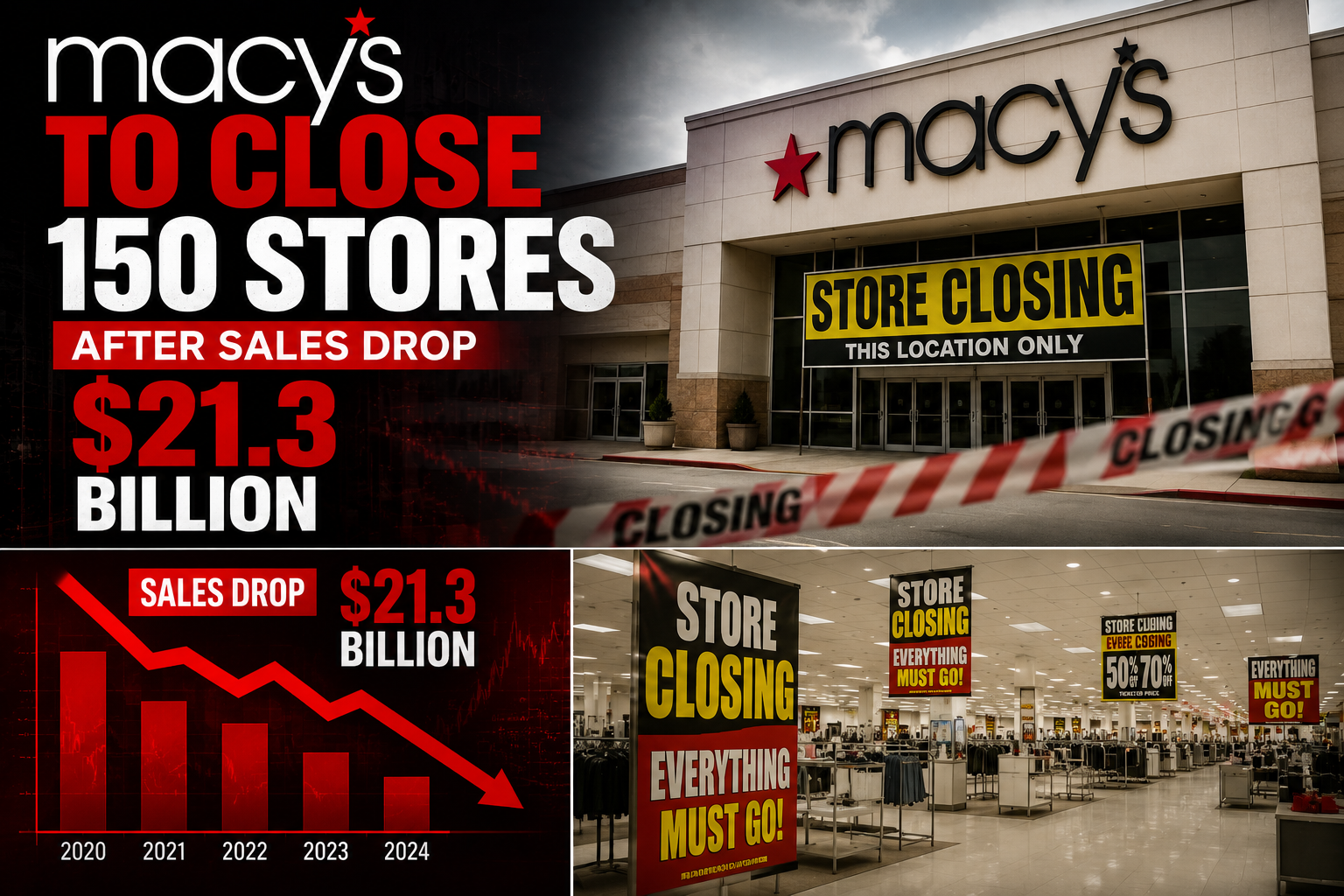
Explore why Macy to Close 150 Stores After Sales Drop $21.3 Billion. Learn about the Bold New Chapter plan, liquidation sales, and the future of retail.
The landscape of American retail is undergoing one of its most dramatic transformations in a generation. For decades, the department store anchor was the undisputed crown jewel of the suburban shopping mall. However, shifting consumer behaviors, the relentless rise of e-commerce, and macroeconomic pressures have forced even the most iconic legacy brands to re-evaluate their physical footprints.
The biggest indicator of this shift came when corporate leadership announced that macy’s to close 150 stores after sales drop $21.3 billion, a massive restructuring move intended to stabilize the company’s financial future.
This topic matters immensely because Macy’s is not just a brand; it is an economic bellwether. When a retail empire with hundreds of locations slashes its footprint by nearly 30%, it sends shockwaves through real estate markets, impacts thousands of jobs, alters local municipal tax bases, and signals a fundamental realignment in how Americans buy goods. This comprehensive guide unpacks the multi-layered factors behind this decision, the strategic blueprint guiding the executive team, and what this structural pivot means for shoppers, employees, and investors alike.
The Retail Landscape Shift: Anatomy of Macy to Close 150 Stores After Sales Drop $21.3 Billion
The catalyst for this massive consolidation is a sobering financial reality. Over successive fiscal cycles, net sales projections dropped into the structural baseline range of $21 billion to $21.4 billion. This Macy’s sales drop $21.3 billion midpoint reality represents a significant contraction from historical post-pandemic highs when consumer spending was artificially buoyed by stimulus waves and immediate revenge-shopping trends.
To understand why sales fell to this level, one must look at the structural erosion of the middle-tier department store market. Today’s consumer landscape is highly bifurcated:
- The Premium High-End: Luxury shoppers continue to patronize specialty boutiques and upscale retailers.
- The Value-Driven Base: Budget-conscious consumers have migrated en masse to off-price giants (like TJ Maxx and Ross) and digital marketplaces (like Amazon).
Caught directly in the middle, Macy’s traditional value proposition—offering a broad range of mid-to-high-tier apparel, home goods, and cosmetics under one massive roof—has struggled to find its footing. The drop in core revenue proved that maintaining underproductive, capital-intensive real estate footprints was no longer sustainable.
Unpacking the “Bold New Chapter” Turnaround Plan
Faced with declining top-line revenues, CEO Tony Spring orchestrated a sweeping strategic counteroffensive known as the Macy’s Bold New Chapter plan. Introduced to challenge the internal status quo, this multi-year initiative shifts the brand away from defense and moves it toward aggressive operational modernization.
The plan is anchored by three primary pillars:
The Three Pillars of the Bold New Chapter Plan:
- Optimizing the Operational Footprint: Closing underperforming “non-go-forward” locations to eliminate structural drag.
- Investing in Core Assets: Funneling capital back into the remaining 350 healthiest storefronts to elevate customer experience.
- Accelerating High-Growth Luxury Banners: Shifting corporate capital allocation toward luxury concepts that yield higher margins per square foot.
Rather than trying to be everything to everyone across an expansive, bloated real estate portfolio, the company is systematically shrinking its physical footprint to become leaner, more digitally agile, and highly profitable.
The Mechanics of Macy’s Closing 150 Stores in 2026
The execution timeline for this real estate reduction is deliberate, concluding with the final phases of Macy’s closing 150 stores 2026. By staggering the store closures across multiple fiscal years, management avoids flooding the commercial real estate market with vacant properties while systematically managing inventory drawdowns.
The internal criteria for closures are strict. In historical retail turnarounds, companies often kept stores open as long as they generated positive cash flow. Under the new strategy, the bar has been raised significantly. The 150 stores slated for closure represent approximately 25% of the company’s total square footage, yet they account for less than 10% of its total net sales.
By lopping off this unproductive tail, Macy’s immediately eliminates hundreds of millions of dollars in operational overhead, maintenance costs, and localized supply chain complexities.
Behind the Numbers: Which Locations Are on the Macy’s Store Closures List?
While the corporate office has fiercely guarded the complete, finalized Macy’s store closures list to protect employee morale and localized sales momentum, tranches of closures have consistently leaked via municipal filings and corporate updates.
The closures are not confined to a single geographic territory; they represent a nationwide pruning of underperforming assets. Geographically, stores on the chopping block are heavily concentrated in mature suburban markets where alternative retail options have siphoned away foot traffic.
| Region / State | Notable Closures & Impacted Areas | Real Estate Status |
| California | San Francisco (Union Square flagship building listed for sale), Los Angeles area | High-value urban real estate being monetized |
| Northeast (NJ, NY, NH) | Suburban mall inline locations | Exiting secondary and tertiary underperforming malls |
| Midwest & South (GA, TX, MI) | Older regional shopping centers | Consolidating geographic overlaps |
A prominent real estate example is the sprawling flagship store in San Francisco’s Union Square. While not among the very first wave of immediate shutdowns, corporate leadership confirmed that the underlying real estate is actively being marketed to buyers, demonstrating that prime real estate value often outpaces the retail profitability of the store itself.
Inside Macy’s Liquidation Sales 2026: What Shoppers Can Expect
For consumers, the immediate consequence of this footprint contraction is the rollout of major store-closing events. The Macy’s liquidation sales 2026 represent a critical phase of the cash-generation strategy. The goal of a corporate liquidation is simple: convert massive mountains of physical inventory into raw liquidity as quickly as possible.
These clearance events follow a highly predictable operational cadence run by third-party liquidation firms:
- Phase 1 (Weeks 1–3): Minor discounts (typically 10% to 30% off) designed to draw in regular shoppers. Coupon exclusions are stripped away, allowing customers to buy premium cosmetics and designer brands at discount rates.
- Phase 2 (Weeks 4–6): Deeper cuts (40% to 60% off) as the selection narrows down to core apparel and seasonal goods.
- Phase 3 (Final Weeks): Extreme clearing prices (75% to 90% off) where even the physical infrastructure—including clothing racks, mannequins, visual displays, and back-room storage shelving—is sold off directly to the public.
The “Reimagine 125” Strategy: Revitalizing the Go-Forward Core
The capital saved by abandoning underperforming real estate is being aggressively reinvested into the remaining 350 locations. The vanguard of this effort is the Macy’s Reimagine 125 strategy. This initiative targeted 125 premier locations to serve as an incubation lab for modernized department store concepts.
The practical changes implemented in these pilot stores have yielded measurable turnarounds, outperforming legacy locations by several percentage points in comparable store sales.
Key Upgrades Under the Reimagine Plan:
- Elevated Staffing Levels: Increasing the density of sales associates in high-touch conversion zones, specifically inside fitting rooms and shoe departments, to eliminate friction during the purchase process.
- Visual Merchandising Revamp: Replacing dense, over-stuffed clothing roundels with clean, curated visual displays and dynamic mannequins that mirror boutique shopping experiences.
- Omnichannel Fulfillment Centers: Redesigning back-rooms to act as hyper-localized mini-fulfillment hubs, drastically speeding up Buy-Online-Pick-Up-In-Store (BOPIS) orders and regional home deliveries.
Pivoting to Luxury: Macy’s Bloomingdale’s and Bluemercury Growth
One of the most fascinating aspects of the restructuring is that while the core Macy’s nameplate is shrinking, corporate parent Macy’s, Inc. is aggressively expanding its footprint elsewhere. The Macy’s Bloomingdale’s Bluemercury growth trajectory indicates a decisive corporate pivot toward premium luxury retail, which boasts superior margins and higher insulation against e-commerce erosion.
The company’s investment strategy includes:
- Bloomingdale’s Expansion: Launching approximately 15 new luxury Bloomingdale’s storefronts, including their highly successful, smaller-format “Bloomie’s” concept that brings a curated luxury edit to affluent suburban strip centers.
- Bluemercury Acceleration: Opening at least 30 new standalone Bluemercury luxury beauty and skincare boutiques, while executing massive aesthetic remodels across 30 existing locations.
Luxury consumers are fundamentally less sensitive to inflationary economic pressures, and by expanding these premium banners, the corporate parent successfully shifts its revenue mix toward highly profitable, resilient demographics.
Human Cost of Restructuring: Analyzing Macy’s Layoffs Impact
Behind the corporate restructuring slides and financial spreadsheets lies a profound human element. The Macy’s layoffs impact is felt across corporate headquarters, regional administrative offices, and the retail floor. When 150 legacy department stores are systematically erased from the map, thousands of retail jobs disappear with them.
To mitigate the public relations and operational fallout, Macy’s has implemented a multi-tiered workforce transition plan:
[Impacted Associate]
       │
       ├─► Option A: Internal Transfer to a "Go-Forward" Location
       │
       ├─► Option B: Transition to Regional Digital Fulfillment Hubs
       │
       └─► Option C: Structured Severance Package & Career Outplacement Services
While corporate transfers help retain experienced talent, the reality remains that regional consolidations inevitably result in net job losses. This disruption extends beyond store walls, impacting independent visual merchandisers, local delivery contractors, and mall security personnel who depend on anchor-store ecosystems.
Wall Street’s Verdict: Macy’s Stock Reaction to the Closures
The investment community’s response to these aggressive maneuvers has been a masterclass in market dynamics. Historically, announcements of mass store closures triggered panic selling. In the modern retail environment, however, the Macy’s stock reaction closures trend proved that Wall Street values fiscal discipline over empty scale.
Stock analysts and institutional investors reacted favorably to the plan for two primary reasons:
- Real Estate Monetization: Closing stores allows Macy’s to unlock the latent value of its real estate portfolio. Asset sale gains have brought in over $144 million in a single fiscal year, cash that can be used to pay down debt or fund stock buybacks.
- Defending Against Activist Takeovers: In recent years, activist investment firms (such as Arkhouse Management and Brigade Capital) launched multi-billion-dollar hostile takeover bids aimed at taking Macy’s private to strip and monetize its undervalued real estate. By executing this aggressive closure and monetization plan internally, CEO Tony Spring successfully demonstrated to shareholders that current management could unlock that real estate value without surrendering control of the company.
The Macro Outlook: Macy’s and the Future of Department Stores
The unfolding saga of Macy’s serves as a definitive case study for Macy’s future of department stores and the broader destiny of retail real estate. The era of the massive, four-story, 200,000-square-foot suburban mall anchor is rapidly drawing to a close.
The future belongs to small-format, off-mall retail ecosystems. Macy’s is actively expanding its footprint of small-format neighborhood stores. These spaces are roughly one-fifth the size of a traditional department store, located in open-air shopping centers close to where affluent customers live, and highly curated with localized inventories.
Ultimately, the department store is not dying; it is migrating. The legacy brands that survive the next decade will be those that view their physical spaces not as mere warehouses for inventory, but as flexible, omnichannel customer acquisition touchpoints.
Conclusion: The Leaner Road Ahead for an American Icon
The reality that macy’s to close 150 stores after sales drop $21.3 billion is a textbook example of corporate survival through strategic contraction. By decoupling itself from low-performing real estate, executing the targeted Macy’s closing 150 stores 2026 initiative, and channeling capital directly into the Macy’s Reimagine 125 strategy, the retailer is successfully charting a sustainable path forward.
For the everyday consumer, the legacy of this pivot will be mixed. While many communities will lose a nostalgic landmark and navigate the messy realities of local liquidations, the remaining “go-forward” stores promise an elevated, modernized, and far more efficient shopping experience. By balancing its core retail operations with luxury growth across Bloomingdale’s and Bluemercury, Macy’s is proving that adaptation, though painful, is the only true antidote to retail extinction
